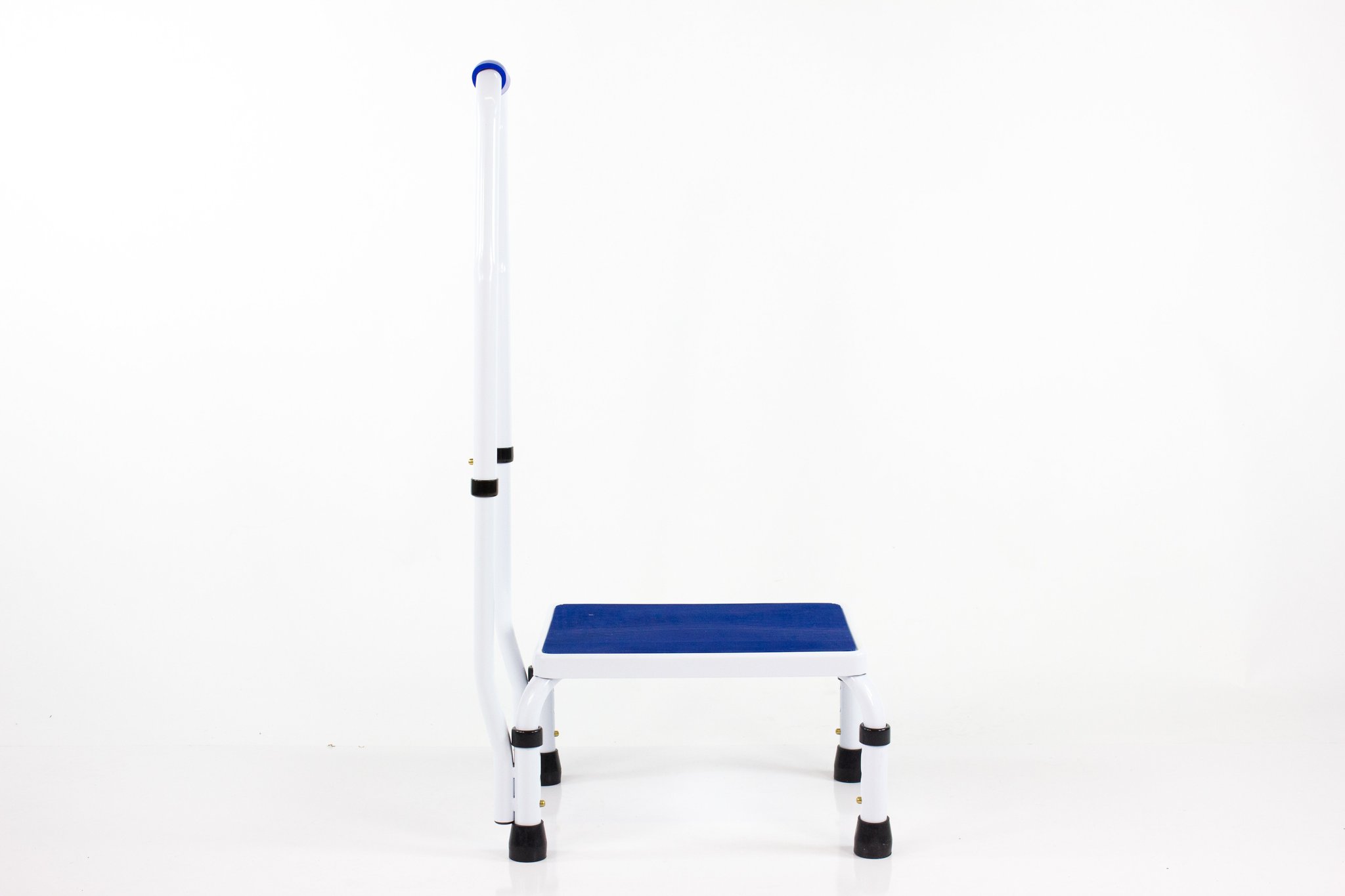
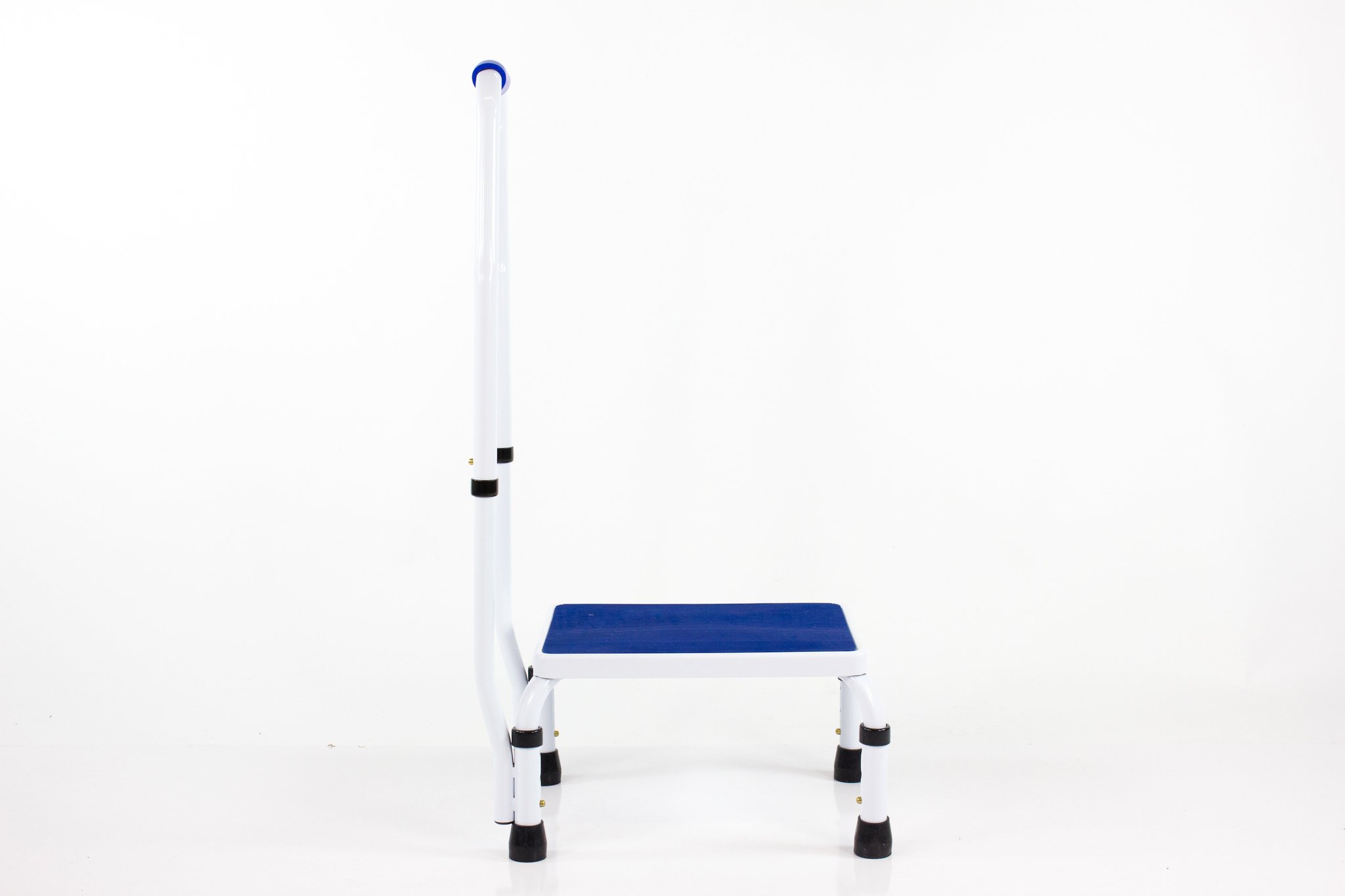
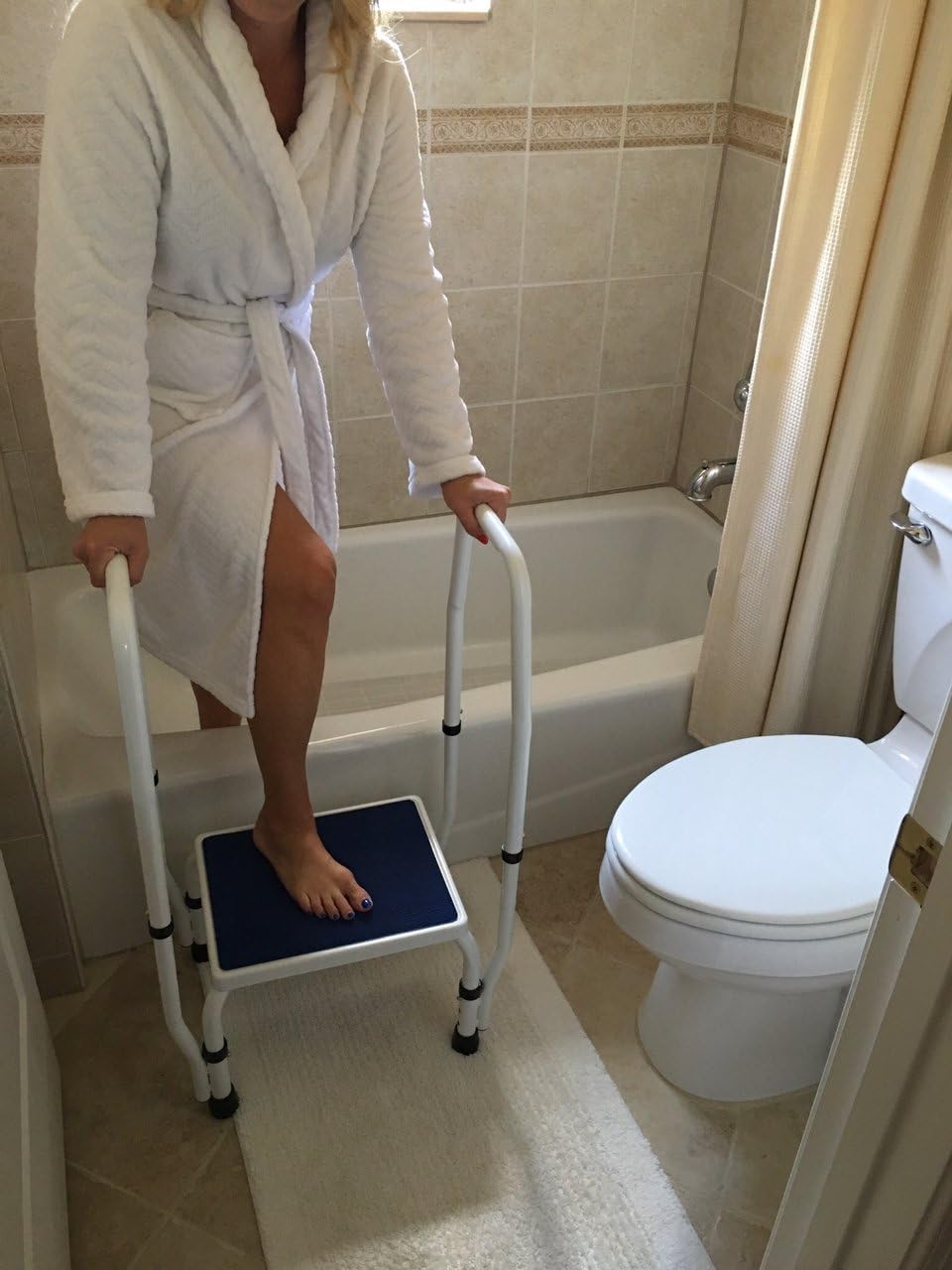
The adjustastep DoubleSafe Deluxe Step Stool/Footstool is an adjustable step stool with two handrails, a non-slip platform, and a steel frame. It is designed to help people step up to beds, chairs, and other raised surfaces with hand support. Its step height has three settings, so buyers can match the stool to their needs. The correct model, weight limit, fit, and safe setup matter before use.
In American homes, a tall bed, a high vehicle seat, or a raised entry can make a simple step feel hard. This can be true for older adults, people with limited mobility, and anyone who finds it hard to lift a leg. A step stool with handrails may help with these tasks, but it must fit the user and the space.
The AdjustaStep DoubleSafe Deluxe is made by Platinum Health. Its main feature is the pair of handrails on either side of the step. The platform and handle heights can be set to suit the task, within the model’s stated adjustment range. This gives buyers more control than a fixed-height stool, though it does not remove the risk of a fall.
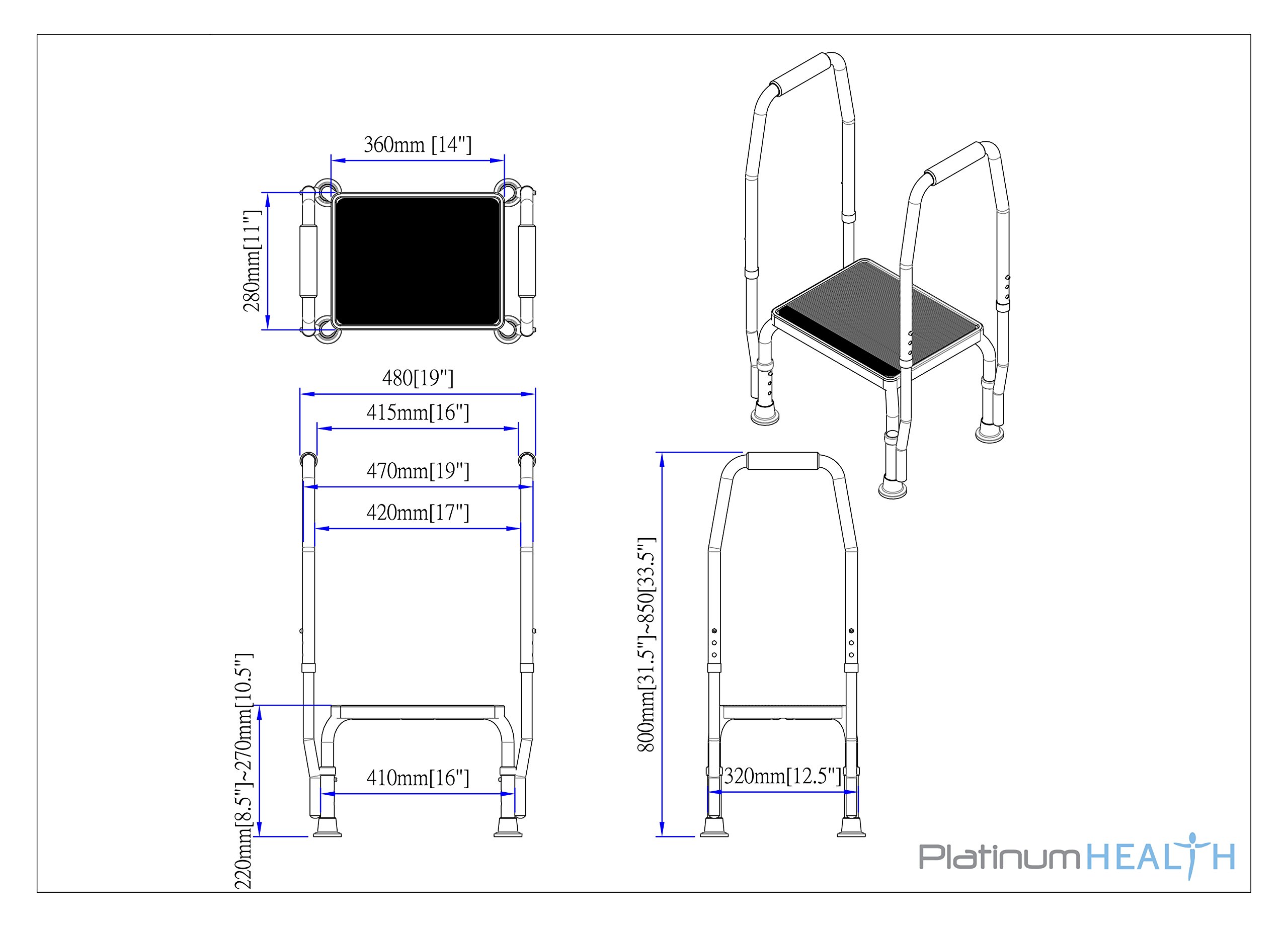
The product details listed by the maker give three platform heights of 8.5, 9.5, and 10.5 inches. The top of the handrails can be set from 31.5 to 33.5 inches above the floor. The platform measures 13.75 by 11.25 inches, and the listed weight limits include 300 pounds and 750 pounds for different versions. Buyers should confirm which version is being sold, since the higher limit does not apply to every unit.
Source: rehabmart.com
What Is the AdjustaStep DoubleSafe Deluxe Step Stool?
The AdjustaStep DoubleSafe Deluxe is a height-adjustable step stool with two handrails. Platinum Health designed it for people who need a step up and want hand support while moving onto or off a raised surface. The product is different from a basic plastic stool because it combines a standing platform with two rails.
The name includes both step stool and footstool because the product can serve as a step in some home tasks. It should not be treated as a simple footrest without checking how the maker intends the selected model to be used. A footrest lets a seated person rest their feet, while a step stool supports standing and stepping. These tasks place different demands on the product.
The two rails offer places to hold while the user moves. The adjustable platform lets the user choose one of three step heights. The design may help with some transfers, but the best setup depends on the person’s strength, balance, range of motion, and ability to follow safe movement steps.
Source: m.media-amazon.com
Dual handrails
Two side rails provide handholds on both sides of the platform. They may be useful for a person who needs support while stepping up or down.
Adjustable platform
The platform has three set heights rather than a continuous height range. The user or caregiver must select the right setting for the task.
Steel construction
Product descriptions list an all-steel frame with a powder-coated finish. The finish is intended to provide a surface that is easier to clean.
Grip features
The product is described as having a non-slip platform and non-slip feet. Grip still depends on the condition of the stool, floor, footwear, and user.
Who May Find It Useful?
This stool may help an adult who needs a small step and stable handholds when getting onto a bed or reaching a raised seat. It may also help a caregiver support a planned transfer, when the person can stand and step safely with the aid. A home user should first check the person’s needs rather than choose by age alone.
People who cannot bear weight on one or both legs, have severe balance problems, or need another person to lift them may need a different aid. A physical therapist or occupational therapist can assess whether a step stool, bed rail, transfer aid, or other device is more suitable.
Possible fit
Adults who can stand, follow directions, and use handrails during a small step, if the device matches their ability.
Needs more review
Users who have fainting spells, sudden weakness, poor balance, severe joint pain, or trouble bearing weight.
AdjustaStep DoubleSafe Deluxe Specifications
The listed dimensions are useful when deciding whether this stool will fit the user and the room. Check the measurements before buying, especially if the stool will sit beside a bed, chair, or narrow doorway. A stool can have the right height yet still be too small for a user’s feet or too wide for the intended space.
The maker lists two weight-capacity options, 300 pounds and 750 pounds. These ratings refer to different versions, not a single unit that can support either limit at will. Confirm the exact model number and rated capacity on the listing and product label. Never rely on a product photo alone to identify the version.
Source: images-na.ssl-images-amazon.com
Platform height
Three settings: 8.5 inches, 9.5 inches, and 10.5 inches from the floor to the top of the step.
Handrail height
The top of the handles adjusts from 31.5 inches to 33.5 inches above the floor.
Platform dimensions
13.75 inches long by 11.25 inches wide, according to the maker’s product details.
Space between rails
17.5 inches between the handrails. Check this against the user’s body size and preferred hand position.
Weight capacity
Versions are listed with 300-pound and 750-pound capacities. Match the rating to the exact model you receive.
Frame and finish
Product descriptions list a steel frame and a powder-coated finish.
How to Read the Weight Limit
A weight limit is a maximum stated load, not a promise that every movement will be safe. A person can create extra force when stepping, shifting weight, or pulling hard on a rail. The stool must be used as directed, and its frame, feet, and adjustment parts must be in good condition.
For example, a buyer who weighs 320 pounds should not choose the 300-pound version. The buyer should confirm that the 750-pound version is a real option for the exact product, then check its instructions and rated use. If a retailer lists only one capacity, do not assume another version will be supplied.
A higher weight rating alone does not prove that the stool is the best choice. Platform size, handrail spacing, floor conditions, and the user’s ability to step safely remain key factors.
Before checkout
Confirm the model number, listed capacity, included rails, and dimensions.
After delivery
Check the label on the actual stool and compare it with the order details.
If details conflict
Do not use the stool until the seller or manufacturer confirms the correct rating.
How the Adjustable Height Works
The platform can be set to three heights: 8.5, 9.5, or 10.5 inches. This gives the user a choice between a lower step and a higher one. The best setting is not always the highest; a lower step may be easier to use when lifting the foot is hard.
The handrails adjust separately within their stated range. The goal is to let the user hold the rails in a position that feels natural while standing and stepping. A rail that is too high or too low may make it harder to keep a steady posture.
The product is described as adjustable without tools, but users should follow the instructions for the exact model. Never change a height setting while someone is standing on the platform. Keep hands and fingers clear of moving parts, and confirm that each adjustment is locked in place before use.
Source: rehabmart.com
Start with the lowest step
When suitable for the task, the 8.5-inch setting may be a useful starting point for checking whether the user can step up and down with control.
Check the reach
Set the handrails so the user can hold them without leaning far forward, twisting, or raising the shoulders in an awkward way.
Check each lock
Inspect all height-adjustment points before the first use and after each change. Do not use the stool if a part feels loose.
Recheck the setting
A setting that works beside one bed may not suit a different bed, chair, or vehicle seat.
Choosing a Step Height for a Bed
Measure the distance from the floor to the top of the mattress, then consider how the user will move onto it. Mattress height alone does not decide the correct stool height. The user’s leg strength, joint movement, and ability to hold the rails also matter.
A stool that is too low may not help enough. A stool that is too high may force the user to lift the foot farther than they can manage. Test the intended setup only when the user can do so safely, with suitable help if needed. If the transfer feels strained or unstable, stop and seek advice from a qualified clinician.
Measure first
Check the floor-to-mattress distance and the room available for the stool.
Keep the movement simple
Avoid a setup that requires the user to twist, reach far across the bed, or step over an obstacle.
Stop if the user struggles
Pain, buckling knees, loss of balance, or a need to pull hard on the rails are signs that the setup may not be suitable.
How to Set Up and Use the Stool
A safe setup starts with a firm, level floor and a clear path. Read the manual for the exact model before adjusting the platform or rails. If the stool arrives with missing parts, damaged feet, bent metal, or unclear adjustment steps, contact the seller or maker before use.
Do not let someone use the stool while it is still being set up. A caregiver should make all required adjustments first, then inspect the stool and the area around it. The user should wear footwear with a secure fit and a sole that grips the floor.
Source: cf1.bettymills.com
1. Check the parts
Look for damage, missing pieces, loose fasteners, worn pads, or bent rails. Do not use a damaged unit.
2. Choose the location
Place the stool on a dry, firm, level surface. Remove rugs, cords, clutter, and other items that may catch a foot.
3. Set the platform
Select the height that suits the task and the user’s ability. Follow the maker’s instructions to lock the adjustment.
4. Set the rails
Adjust the handles within the allowed range. Confirm that they are secure before the user holds them.
5. Check the base
Make sure all feet touch the floor and the stool does not rock or slide under gentle pressure.
6. Review the movement
If the person can safely use the stool, approach it slowly and hold both rails as directed. Do not jump, rush, or use the stool as a ladder.
Signs the Setup Is Not Right
Stop if the stool rocks, slides, or shifts when the rails are held. The same applies if an adjustment will not lock, a foot pad is missing, or the platform surface is damaged. These are not small issues to ignore.
The setup may also be wrong if the user’s feet do not fit on the platform, the rails feel too far apart, or the person must lean heavily to reach the next surface. A person who needs strong pulling force to rise may need a different transfer aid.
Loose or uneven base
Remove the stool from use until the cause is found and corrected according to the manual.
Pain or loss of balance
Stop the movement. Do not keep trying a higher or lower setting without reviewing the person’s needs.
Unclear adjustments
Ask the seller or manufacturer for the correct instructions rather than guessing how the parts fit.
Safety Features and Their Limits
The AdjustaStep DoubleSafe Deluxe combines two handrails, a non-slip platform, non-slip feet, and a steel frame. These features are intended to give the user grip and support during a step. They can help with setup, but no single feature can prevent every fall.
The rails are handholds, not a reason to pull with all your strength or hang your full body weight from them unless the maker’s instructions specifically allow that use. The stool should not be used to reach high shelves, stand for long tasks, or climb onto a surface beyond the planned step. A short platform can still be unstable when used in the wrong way.
Wet tile, soap, dust, loose rugs, and worn foot pads can reduce grip. This matters in bathrooms and near entry doors, where floors may be damp. Do not assume that a non-slip label makes the stool suitable for use inside a shower or on a wet floor.
Source: m.media-amazon.com
Use a dry floor
Keep water, soap, oil, and loose debris away from the base and platform.
Do not overreach
Keep the body close to the handrails and avoid twisting or leaning far to one side.
Never exceed the rated load
Use only the capacity shown for the exact model. Include the user’s full body weight in the check.
Do not use a damaged stool
Bent rails, loose joints, worn feet, or a cracked platform are reasons to stop use.
Supervise when needed
A person with limited balance or a history of falls may need professional guidance and hands-on assistance.
Can It Help Prevent Falls?
Handrails and grip surfaces may reduce some risks when a person can step safely and the stool is set up correctly. The product description alone does not prove that it prevents falls in every user or setting. The result depends on the person’s ability, the surface, the chosen height, and how the stool is used.
For someone who has fallen often, feels dizzy when standing, or cannot bear weight reliably, a step stool may not be the right answer. A clinician can review the movement and recommend equipment that fits the person’s needs. A proper assessment is more useful than relying on the product name or marketing claims.
Potential benefit
The user has two rails to hold while making a small, controlled step.
Key limit
The device cannot correct poor balance, sudden weakness, unsafe footwear, or an unsuitable transfer.
Where Can You Use the AdjustaStep DoubleSafe Deluxe?
The stool may be useful in a bedroom or another dry indoor area where a small step and hand support are needed. A bedside setup is one common use to consider, provided the floor is firm and the stool does not block a clear path. The right use depends on the product instructions and the person’s ability.
Some buyers may consider it for access to a raised chair or vehicle seat. These uses need care because the floor, door opening, seat height, and room to move can differ a lot. A stool that works next to a bed may not fit safely beside a car. Never place the stool on a slope or an uneven outdoor surface to make it reach a vehicle.
A bathroom can be a challenging place for any step stool because water and soap may make surfaces slick. Unless the exact model instructions approve the intended conditions, do not use it in a shower or on a wet floor. For bathing or toilet transfers, a purpose-built bath or toilet aid may be more suitable.
Source: images-na.ssl-images-amazon.com
Bedroom
Consider the stool for a suitable bedside step only after checking bed height, floor space, and the user’s movement.
Raised chair
Check that the stool can be placed squarely and that the user can step between the stool and seat without twisting.
Vehicle access
Confirm the surface is level, the stool is stable, and the device is approved for the intended use. Do not use it if a door or body position blocks safe movement.
Bathroom
Avoid wet or soapy floors. Use only in conditions allowed by the maker’s instructions.
Is It a Good Choice for an Older Adult?
It may suit an older adult who can stand and take a small step but wants two handholds for added support. Age by itself does not determine whether the stool is suitable. The key questions are whether the person can bear weight, move each leg as needed, grip the rails, and stay steady throughout the transfer.
A person who needs to be lifted, cannot stand without strong help, or becomes faint when upright should not try the stool without professional advice. A therapist can assess the bed, chair, or vehicle and suggest a safer plan. Caregivers should not attempt a transfer that risks injury to either person.
May suit
A user who can step and stand with control and can hold both rails.
Needs an assessment
A user with severe balance problems, recent surgery, sudden weakness, or limited weight-bearing ability.
How It Compares With a Basic Step Stool
The main difference between this model and a basic household stool is the pair of handrails and the adjustable platform. A simple stool may cost less and take up less room, but it may offer no hand support. A taller stool can help with reach, yet it may not suit a person who needs a low step and a place to hold.
A rail-equipped step stool is not always the right option. It takes more space than a small plastic stool, and its platform is still limited in size. Some people may need a full transfer aid, a bed step with a wider base, or a professionally fitted support rail instead.
Source: cf1.bettymills.com
Basic plastic step stool
Often compact and simple to move, but typically lacks the dual handrails and height adjustment of the AdjustaStep DoubleSafe Deluxe.
Single-handrail stool
May use less space and give support on one side, but offers fewer handhold choices than a dual-rail design.
Dual-handrail adjustable stool
Offers handholds on both sides and three platform heights, but needs enough floor space and a user who can step safely.
Transfer equipment
May be more appropriate when a person cannot safely step up or needs help moving between a bed, chair, or wheelchair.
What Should You Compare Before Buying?
Compare the product’s height settings, platform size, rail spacing, weight capacity, and floor grip. Then compare the space it needs with the place where it will be used. Do not focus only on price or the highest weight rating.
Also check how the product ships, whether assembly is needed, what the warranty covers, and whether the seller accepts returns. Medical and mobility products may have special return rules. A retailer may list a product as non-returnable, so read the terms before placing an order.
Fit
The user’s feet must fit on the platform, and the rail spacing must allow a comfortable grip.
Rated load
Confirm the precise model and its marked weight capacity.
Use setting
Check whether the stool is suitable for the intended location and task.
Ownership costs
Review price, shipping, return costs, warranty, and the availability of replacement parts.
Price, Availability, Warranty, and Buying Checks
The price of the AdjustaStep DoubleSafe Deluxe can vary by seller, selected weight capacity, stock status, and condition. A listing may show a new item, a reconditioned item, or a version with different features. Treat the price on a product page as a current offer only after checking the seller’s live listing and the selected option.
The manufacturer’s store has listed the dual-handrail model with 300-pound and 750-pound capacity choices, but product availability can change. Some retailer pages may show a different price or may list the item as sold out. Do not assume a product is in stock just because its page remains online.
A reconditioned unit may cost less, but the condition and warranty may differ from a new unit. Review what was inspected, what parts are included, and whether the seller covers defects. Ask about worn pads, loose adjustments, missing hardware, and any cosmetic damage that could hide a larger problem.
Source: m.media-amazon.com
Check the exact model
Make sure the listing says DoubleSafe Deluxe and clearly identifies the dual-handrail design.
Verify capacity
Confirm the selected model’s weight rating before checkout and again when it arrives.
Check the seller
Review the seller’s contact details, shipping terms, return rules, and product support.
Review warranty coverage
Ask how long the warranty lasts, which parts it covers, and whether labor, shipping, or damage from misuse is excluded.
Inspect used or reconditioned items
Check the frame, adjustment points, rail grips, platform, and feet before allowing anyone to use the stool.
Questions to Ask the Seller
A short check with the seller can prevent a costly mistake. Ask for the exact model number and a written confirmation of the weight capacity. If the listing does not show the product label or adjustment instructions, request them before buying.
Also ask whether the stool arrives assembled, whether all original parts are included, and how a defect is handled. If the item is intended for a person with a medical or mobility need, confirm that the selected product matches the advice given by their care team.
Model and capacity
Which exact model is being sold, and what weight limit is printed on its label?
Included parts
Are both handrails, the platform, all feet, and the adjustment parts included?
Returns
Can the item be returned if its dimensions do not fit the intended space?
Warranty
What defects are covered, and what proof of purchase is required?
Cleaning, Care, and Long-Term Use
Regular checks help you spot wear before it becomes a problem. Look at the feet, platform, handgrips, frame, and height-adjustment points. The stool should feel firm, with no loose parts, sharp edges, unusual movement, or damaged coating that affects safe use.
Use the cleaning method stated in the manufacturer’s instructions. Product descriptions identify a powder-coated finish that is intended to be easy to clean, but this does not mean every disinfectant or harsh chemical is suitable. Avoid soaking adjustment parts or using a cleaner that may harm the surface or grip pads.
Let cleaned surfaces dry fully before use. Moisture on the platform or floor can reduce grip, even if the stool itself has non-slip features. Do not use oils, wax, or other products that may leave the standing area slick.
Source: rehabmart.com
Inspect before use
Check for loose parts, worn feet, bent rails, or damage to the platform.
Clean as directed
Follow the maker’s cleaning guidance and use products that are suitable for the finish and grip surfaces.
Keep it dry
Dry the stool and floor before stepping onto it.
Store it safely
Keep the stool where it cannot block a walkway or create a trip hazard.
Stop using damaged parts
Do not tape over a damaged rail or add an improvised repair to a load-bearing part. Contact the maker or seller for an approved fix.
When Should You Replace the Stool?
Replace the unit or seek an approved repair if the frame bends, the platform cracks, the rails loosen, or the feet no longer grip as intended. A stool that rocks or shifts should not remain in service while you wait to see whether the problem gets worse.
Worn grip pads and damaged adjustment parts can affect how the stool behaves. Ask the maker whether replacement parts are available for the exact model. If the product has been dropped, overloaded, or used in a way that may have damaged its frame, have it checked before using it again.
Remove from use
Stop use if the stool is unstable, bent, cracked, or missing a key part.
Seek approved service
Ask the maker about replacement parts or repairs that meet its instructions.
Do not guess
If the frame or weight-bearing parts may be damaged, replacing the stool may be safer than attempting an improvised repair.
Common Buying and Use Mistakes
The most common mistake is choosing the stool by appearance or price without checking its size and weight limit. A stool may look right online but have a platform that is too small for the intended user. The rail spacing may also affect how well the user can hold it.
Another mistake is assuming that adjustable height means the stool will suit every bed, chair, or person. It only provides three platform settings and a limited rail-height range. Some transfers need a different aid or a change to the room setup.
Buyers should also avoid using the stool on a wet floor, moving it while someone stands on it, or treating the handrails as a way to pull the body upward with force. These choices can make a stable product unsafe. Use the device only for its intended task and follow the supplied instructions.
Source: cf1.bettymills.com
Mistake: Assuming every version supports 750 pounds
Correction: Check the selected model and the actual label. The product family includes different rated capacities.
Mistake: Ignoring platform size
Correction: Compare the 13.75-by-11.25-inch platform with the user’s foot size and movement.
Mistake: Using it on a wet surface
Correction: Keep the base and platform dry and use a firm, level floor.
Mistake: Adjusting it under load
Correction: Make height changes only when no one is on the stool and follow the manual.
Mistake: Treating rails as a lifting device
Correction: Use the handrails as directed. Seek a suitable transfer aid if the user needs to be lifted or cannot step safely.
Mistake: Skipping the return policy
Correction: Check the retailer’s rules before purchase, especially for medical and mobility equipment.
What If the Stool Feels Unstable?
Stop using it at once. Move the user away with suitable help, then inspect the floor, feet, adjustment points, and frame. Make sure the stool is on a level surface and that no rug or loose item is under its base.
If the stool still rocks, slides, or shifts, do not try to fix the issue by placing cardboard, folded towels, or other loose items under it. Check the manual and contact the seller or maker. A stability problem must be resolved before anyone uses the stool again.
First check
Look for a sloped floor, debris, loose parts, worn pads, or an adjustment that is not locked.
If the issue remains
Remove the stool from use and request approved support or repair.
Frequently Asked Questions
Q
What is the AdjustaStep DoubleSafe Deluxe Step Stool used for?
The AdjustaStep DoubleSafe Deluxe is designed to provide a small step and two handrails for supported access to raised surfaces. It may be useful beside a bed or another suitable household seat when the user can step safely. The intended task, user ability, and product instructions should guide the choice.
Q
How high can the AdjustaStep DoubleSafe Deluxe step be?
The listed platform settings are 8.5 inches, 9.5 inches, and 10.5 inches from the floor to the top of the step. The platform does not adjust continuously between these heights. Follow the product instructions when changing settings.
Q
What is the weight capacity of the AdjustaStep DoubleSafe Deluxe?
The product family is listed with 300-pound and 750-pound capacity options. These are different versions, so the higher rating should never be assumed. Check the exact listing, model number, and product label before use.
Q
Can the AdjustaStep DoubleSafe Deluxe be used for getting into bed?
It may help a person who can safely make a small step and use both handrails. Measure the bed height, check the available floor space, and confirm that the user’s feet fit on the platform. If the person cannot bear weight, has poor balance, or needs lifting help, seek advice from a physical therapist or occupational therapist before choosing a transfer aid.
Q
Is the AdjustaStep DoubleSafe Deluxe safe for a shower?
Do not assume it is safe for use in a shower or on a wet bathroom floor. Water and soap can reduce grip, even when a product has a non-slip platform and feet. Check the exact model’s instructions and choose equipment designed for wet-area use when needed.
Q
Does the AdjustaStep DoubleSafe Deluxe need tools for adjustment?
The maker’s product description states that its height adjustments can be made without tools. The user should still follow the supplied instructions and confirm that each adjustment locks in place. Never change the setting while a person is standing on the stool.
Q
How do you clean the AdjustaStep DoubleSafe Deluxe?
Follow the cleaning directions supplied for the exact model. Use a suitable cleaner for the powder-coated finish and grip surfaces, and avoid products that leave the platform slick or damage the pads. Let the stool and floor dry fully before use.
Q
Where can you buy the AdjustaStep DoubleSafe Deluxe?
The stool has been listed by Platinum Health and medical equipment retailers. Stock, price, available weight capacities, and return terms can vary. Check the current product listing and confirm the model and capacity with the seller before ordering.
✦ Wrapping Up
Conclusion
The AdjustaStep DoubleSafe Deluxe Step Stool/Footstool is an adjustable step stool with two handrails, a steel frame, and a non-slip platform and base. Its three step heights and adjustable rails may help some people move onto a bed or raised seat with hand support. The platform is 13.75 by 11.25 inches, and the listed step heights are 8.5, 9.5, and 10.5 inches.
The right choice depends on more than the product name. Check the exact weight capacity, rail spacing, platform size, floor conditions, and intended use. A user who cannot step safely or needs strong lifting help may need a different device and professional guidance. Current stock, price, warranty terms, and return rules should also be checked with the seller.
💡 Key Takeaway
Before buying, measure the intended space, compare the user’s needs with the platform and rail dimensions, confirm the exact model’s weight rating, and review the instructions and return policy. Before each use, check that the stool is stable, dry, undamaged, and locked at the correct height.