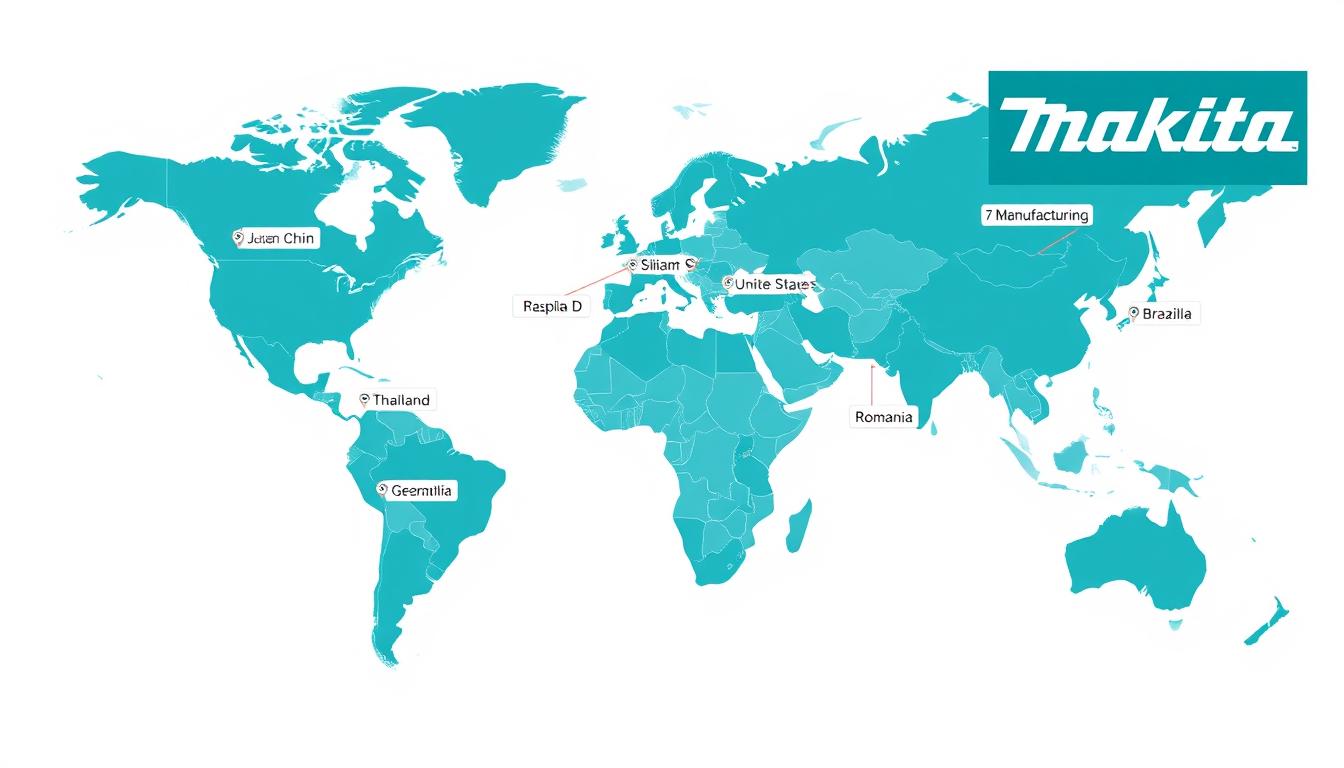
Makita tools are manufactured in several countries, including Japan, China, Thailand, Romania, the United Kingdom, Germany, Brazil, and the United States. The country of origin depends on the product and model.
When buying a power tool in the United States, the name on the box does not always tell you where the tool was built. Makita is a Japanese company, but its manufacturing network reaches far beyond Japan. The brand makes tools at plants in several countries to serve customers around the world.
Makita’s official company information confirms that it operates manufacturing plants in eight countries. The company also reports that roughly 90% of its products, measured by production volume, are made outside Japan. That figure describes its global production, not the origin of every drill, saw, battery, or charger.
For US shoppers, the most useful step is to check the label on the exact tool. A Japanese brand name does not prove that a product was made in Japan, and a tool made in another country is not automatically a lower-quality product. The model, product type, manufacturing origin, and applicable US warranty all matter.
Source: drillmaxxtools.com
Where Are Makita Tools Made?
Makita tools are made in eight countries: Japan, China, Thailand, Romania, the United Kingdom, Germany, Brazil, and the United States. These locations form part of the company’s worldwide manufacturing network. Makita uses this network to make and supply products for different markets.
Japan remains the company’s home base. However, it is not the sole source of Makita products sold in the United States. A cordless drill, an angle grinder, a lawn tool, and a charger may come from different manufacturing locations, even when they share the same brand.
Makita’s official global company information lists these eight manufacturing countries. The exact mix of products made at each plant can change as the company adjusts its production and supply needs. Therefore, a general country list cannot identify the origin of every individual tool.
Source: vsanalysis.com
Japan
Makita’s home country, with its corporate headquarters and major production facilities, including the Okazaki Plant.
China
A major manufacturing location with Makita production operations in Kunshan and other facilities.
Thailand
Part of Makita’s Asian manufacturing network, with power tool production beginning in 2012.
Romania
A European manufacturing location that supports Makita’s production and supply network.
United Kingdom
Home to a Makita manufacturing operation serving the company’s wider production network.
Germany
Part of Makita’s European manufacturing structure, including operations associated with its engineering and outdoor equipment business.
Brazil
A manufacturing location within Makita’s international network in South America.
United States
Makita has manufacturing and assembly operations in Buford, Georgia.
Does Makita Make Most of Its Tools in Japan?
No. Makita is Japanese, but its manufacturing is spread across several countries. The company’s published global information states that about 90% of its products, measured by production volume, are manufactured overseas. This means production outside Japan accounts for most of its total output.
That figure should not be read as a promise about any one product. It does not mean that 90% of tools sold in America come from one foreign country, nor does it identify the origin of a specific model. For that, the product label is more useful than a company-wide percentage.
Brand origin
Japan is where Makita began and where its corporate headquarters are located.
Manufacturing origin
The actual country where a particular tool was made or assembled.
Makita Manufacturing Locations Around the World
Each country in Makita’s network has a role in the company’s broader production system. The company maintains manufacturing operations in several regions rather than relying on a single factory for all its products. This arrangement helps it respond to local demand and manage supply across different markets.
The list below describes the confirmed countries in Makita’s manufacturing network. It does not assign a specific drill, saw, battery, or accessory to a factory without model-level evidence. Factory assignments can differ by product line and may change over time.
Source: vsanalysis.com
Japan: corporate and production base
Makita’s headquarters are in Aichi Prefecture, Japan. The Okazaki Plant is one of its named production facilities. Japan also plays a role in developing manufacturing methods and production technology.
China: major production base
Makita operates Chinese manufacturing facilities, including Makita (China) Co., Ltd. and Makita (Kunshan) Co., Ltd. China is an established part of its global production system.
Thailand: Asian manufacturing
Makita established its Thai manufacturing company in 2011 and began power tool production there in 2012.
Romania: European production
Makita’s Romanian operation supports its European manufacturing network and helps supply products to markets in the region.
United Kingdom: manufacturing in Europe
Makita Manufacturing Europe Ltd. is among the company’s documented overseas production operations.
Germany: manufacturing and engineering
Makita Engineering Germany GmbH is part of its overseas network. Germany also has a connection to the company’s long-running outdoor power equipment business.
Brazil: South American production
Makita do Brasil Ferramentas Elétricas Ltda. is listed among the company’s production operations.
United States: domestic manufacturing and assembly
Makita Corporation of America operates in Buford, Georgia, where the company has manufacturing and assembly operations.
Why Does Makita Use So Many Countries?
A global factory network lets Makita produce and supply tools closer to different markets. It can also help the company respond to changes in demand, shipping needs, currency conditions, and supply risks. A factory network gives the company more options than relying on one country alone.
Makita has also described sharing manufacturing knowledge and production methods across its plants. The company says this approach helps maintain consistent production quality. However, a global quality system does not mean every product uses the same parts or follows an identical production route.
Supply flexibility
Multiple production locations can help the company respond to changes in regional demand.
Regional supply
Manufacturing in different regions can support more direct supply to nearby markets.
Shared production methods
Makita says its plants share manufacturing expertise and use production technology to support consistent quality.
Are Makita Tools Made in the USA?
Yes, some Makita tools are manufactured or assembled in the United States. Makita’s US manufacturing operation is in Buford, Georgia, under Makita Corporation of America. The company states that it began manufacturing and assembling tools at this location in 1985.
This is a real part of Makita’s history, but it does not mean all Makita tools sold in America are made in Georgia. The company also imports products from its overseas manufacturing network. A tool bought at a US retailer may therefore have a US, Japanese, Chinese, or other listed country of origin.
The distinction between manufacturing and assembly matters. A product assembled in the United States may contain parts made elsewhere. The correct country-of-origin description depends on the product and the applicable labeling rules, so do not assume that a US assembly location means every component was made in America.
Source: www.slashgear.com
US manufacturing location
Buford, Georgia, is the documented location of Makita Corporation of America’s manufacturing and assembly operations.
US headquarters and distribution
Makita U.S.A., Inc. has its home office in La Mirada, California, and operates a US distribution network. A distribution address is not proof of the factory where a tool was made.
Imported tools
Many Makita products sold in the United States come from overseas manufacturing facilities.
How Can You Tell if a Makita Tool Was Made in America?
Start with the country-of-origin marking on the product or its packaging. Look for wording such as Made in USA, Made in China, Made in Japan, or another stated country. If the marking is not visible, check the product documentation or contact Makita support with the exact model number.
Do not use the retailer’s location, the color of the tool, or the address of Makita’s US office as proof of origin. Those details can identify the seller or brand’s local operation without showing where the individual product was manufactured.
Check the tool
Inspect its body, nameplate, or other manufacturer markings.
Check the packaging
Keep the original box and read its country-of-origin statement.
Ask Makita
Provide the exact model and, if requested, the serial or production details so support can help identify the product.
Are Makita Tools Made in China?
Yes. China is one of Makita’s established manufacturing countries. The company has Chinese production operations, including Makita (China) Co., Ltd. and Makita (Kunshan) Co., Ltd. A Makita tool marked Made in China is therefore consistent with the brand’s documented manufacturing network.
China is not the only overseas source for Makita products. Tools can also come from Thailand, Romania, the United Kingdom, Germany, Brazil, or the United States, depending on the product. The country printed on the actual item is more reliable than a general claim about where the brand makes its tools.
A country label alone does not tell you how long a tool will last or how well it will perform. Those outcomes depend on the design, materials, components, intended use, maintenance, and the conditions under which the tool is used. A country-of-origin comparison cannot replace model-specific evidence.
Source: vsanalysis.com
China is a confirmed manufacturing location
Makita’s global company information identifies two Chinese production companies.
Not every Makita product is made in China
The brand has manufacturing operations in seven other countries as well.
Origin is not a quality grade
The label identifies manufacturing origin; it does not establish a tool’s performance or lifespan.
Is a Makita Tool Made in China Fake?
No. A Made in China label does not, by itself, mean a Makita tool is counterfeit. China is a documented location in Makita’s official manufacturing network. A genuine tool can be produced there and sold through an authorized retailer.
If you are unsure whether a tool is genuine, consider the seller, the model number, the packaging, the product markings, and the available purchase records. A suspiciously low price or unusual packaging may justify further checks, but no single sign proves that a tool is fake.
For a reliable answer, contact Makita’s official support team or an authorized dealer. Share clear photos and the model details. Avoid trying to verify authenticity from the country label alone.
Check the seller
Buy from a reputable dealer and retain the receipt.
Check the model
Compare the exact model number and product details with Makita’s official information.
Ask for verification
Contact Makita if the markings, packaging, or seller information raise concerns.
Are Makita Tools Made in Japan Better?
You cannot reliably judge a Makita tool’s quality from its country of manufacture alone. Japan is the company’s home base and an important production location, but Makita also operates factories in seven other countries. Its published manufacturing approach emphasizes shared knowledge and consistent production methods across its network.
Some buyers prefer a Japanese-made tool because they value its origin or want a product made in a particular country. That preference is reasonable when country of origin is a personal buying requirement. Still, the label does not prove that a particular tool is stronger, lasts longer, or performs better than a similar model made elsewhere.
A fair comparison starts with the exact models. Look at power, speed, torque where relevant, weight, ergonomics, battery platform, parts availability, service support, warranty terms, and the type of work the tool must handle. These details are more useful for a purchase decision than a broad claim about one country’s factories.
Source: cisivistools.com
Compare the intended use
A tool built for light home repairs may not suit daily heavy construction work, regardless of its manufacturing country.
Check the model specifications
Use official specifications to compare the features that matter for your job.
Review repair support
Parts, service access, and warranty coverage can affect the value of a tool over time.
Treat country claims carefully
Do not accept claims that all tools from one country are better or worse without sound model-specific evidence.
Does the Factory Location Affect Quality Control?
A factory’s processes can affect the consistency of the products it makes. Makita states that it shares manufacturing expertise and uses in-house production technology, including robots, to support stable quality across its plants. This is a documented description of the company’s approach, not independent proof that every individual tool will be defect-free.
Any manufactured tool can have a fault, regardless of its origin. Proper use, correct accessories, suitable maintenance, and timely repair all matter. If a tool develops an issue, follow the manual and warranty instructions rather than assuming the country printed on the label explains the fault.
Manufacturing consistency
Shared methods can help standardize production across factories.
Product-specific checks
Inspect the exact model’s specifications, markings, and condition.
Service and repair
Use authorized support for faults that require technical inspection or warranty service.
How to Check Where Your Makita Tool Was Manufactured
The most reliable way to identify the manufacturing country of a particular Makita tool is to read the country-of-origin marking on that item or its original packaging. If the marking is missing or unclear, use the exact model information and ask Makita support. A brand-wide factory list can narrow the possibilities, but it cannot confirm an individual tool’s origin.
This is especially useful when shopping online in the United States. Retail listings may describe a product’s features without clearly stating its manufacturing country. Ask the seller for a clear label photo if origin is a deciding factor before you place an order.
Source: cisivistools.com
Step 1: Find the model number
Look for the model designation on the tool, nameplate, manual, or box. Record the complete number, including letters and suffixes.
Step 2: Read the country marking
Check the tool and packaging for the stated country of origin. Do not confuse a serial number, voltage rating, or importer address with the manufacturing country.
Step 3: Review the manual
Read the product documentation for model-specific information. A manual may provide useful identification details, although not every manual states the manufacturing country.
Step 4: Check official support
Use Makita’s official website or contact its support team. Supply the model number and any other identification details requested.
Step 5: Confirm before buying
If a specific country of origin matters to you, ask the retailer to confirm the marking on the actual item rather than relying on a general product description.
What if the Tool and Box Show Different Information?
Do not guess if the markings seem inconsistent. Packaging may be changed, replaced, or used for more than one market, and the exact explanation depends on the product. Check the model and any available serial or production details, then ask Makita or the seller to clarify the discrepancy.
Keep your receipt, photos of the label, and the product documentation. These records can help with product identification, warranty questions, and a return if the item does not match the seller’s description.
Keep clear records
Photograph the tool label, packaging, and model information.
Avoid unsupported conclusions
A mismatch needs checking; it does not automatically prove that the tool is counterfeit.
Contact the right source
Ask Makita or the retailer to confirm the product details before making a decision.
Does Manufacturing Country Affect Makita Warranty Coverage?
Manufacturing country alone should not be used to determine warranty coverage. For a US buyer, the product’s eligibility, model, purchase history, seller, and the terms that apply to the specific item are more useful factors. A tool made overseas may be covered by a US warranty when sold through the proper channel, but the exact terms must be checked.
Before buying, review Makita’s current US warranty information and confirm whether the product is eligible. Keep the receipt and note the model number. If the tool was purchased outside the United States, do not assume that the same warranty terms or service process will apply in America.
Warranty periods and exclusions can differ among product categories and regions. Do not rely on an old forum post or a seller’s general statement when the current official terms are available. For a used tool, also ask whether the warranty applies to the new owner and whether proof of the original purchase is required.
Source: cisivistools.com
Check the current US terms
Use Makita’s official US warranty information rather than assuming every tool has the same coverage.
Keep proof of purchase
Save the receipt and any order confirmation that identifies the seller and product.
Verify imported products
Ask Makita whether a product purchased abroad is eligible for service or warranty support in the United States.
Confirm before paying
Resolve warranty questions before purchase if the tool is used, imported, or sold by an unfamiliar retailer.
Should You Avoid a Makita Tool Made Overseas?
No. There is no sound reason to reject a Makita tool simply because its label names a country outside Japan or the United States. The company operates a documented international manufacturing network and says it shares production methods among its plants.
A better buying decision weighs the tool’s specifications, suitability for your work, price, condition, battery compatibility, service access, and warranty eligibility. If country of origin is a personal requirement, verify it directly. Otherwise, let the model’s documented features and support terms guide the choice.
For home users
Focus on ease of use, the tasks you need to complete, and the cost of the full setup.
For tradespeople
Consider daily workload, downtime, replacement parts, service access, and battery availability.
For origin-conscious buyers
Confirm the actual product marking before buying instead of relying on the brand’s country of origin.
How Makita’s Global Manufacturing Network Works
Makita’s manufacturing network combines product development, production, and supply operations across several countries. The company explains that it shares production methods and manufacturing expertise among factories. This structure helps it respond to market demand while working toward consistent product quality.
The company also has a long history of developing power tools and cordless products. Its corporate headquarters in Japan remains central to the business, while overseas plants help serve customers in different regions. Manufacturing location and brand ownership are separate facts: a tool made overseas can still be a genuine Makita product.
It is useful to distinguish a factory from a sales office, warehouse, or distribution center. A local address on a website or shipping label may belong to one of these operations. It does not necessarily identify the factory where the tool was built.
Source: cisivistools.com
Research and development
Makita develops products and manufacturing methods to meet the needs of users and markets.
Manufacturing
Production facilities build products within the company’s international network.
Distribution
Warehouses and distribution centers help move products to retailers and customers.
After-sales service
Service operations help customers address faults and arrange repairs under applicable terms.
Does Every Makita Factory Make Every Tool?
No public brand-wide list can establish that every Makita factory makes every product. Different plants can have different roles, equipment, and product assignments. Those assignments can also change as production needs shift.
For this reason, it is better to confirm the country on a particular tool than to infer its origin from a factory photograph or a general map. A map can show where Makita has production facilities, but it does not establish which facility made an individual unit.
Factory lists
Useful for understanding the brand’s manufacturing footprint.
Product labels
More useful for identifying the stated country of origin of a specific item.
Official support
Useful when markings are missing, unclear, or inconsistent.
Frequently Asked Questions
Q
Is Makita a Japanese company?
Yes. Makita is a Japanese company founded in 1915. Its corporate headquarters are in Aichi Prefecture, Japan. The company now operates manufacturing facilities in several countries, so its Japanese identity does not mean every tool is made in Japan.
Q
Which country makes the most Makita tools?
Makita has historically identified China as a major production location, and its global manufacturing network includes two Chinese production companies. However, the precise current share made in each country should not be assumed without current, comparable production data. The origin of an individual tool should be checked on its label.
Q
Are Makita drills made in Japan or China?
Makita drills may come from different manufacturing locations, and the answer depends on the exact model and production run. Japan and China are both part of the company’s manufacturing network, along with several other countries. Check the drill’s country-of-origin marking or ask Makita support to verify the model.
Q
Are Makita batteries and chargers made in the same country as the tool?
Not necessarily. A battery, charger, and power tool are separate products and may have different manufacturing origins. Check the label on each item rather than assuming that the full kit came from one factory. This is especially useful when replacing a missing battery or charger.
Q
Does Made in China mean a Makita tool is counterfeit?
No. China is an official Makita manufacturing location. A Made in China marking alone is not evidence that a tool is fake. If you have concerns about authenticity, review the seller, model number, product markings, and purchase records, then contact Makita or an authorized dealer.
Q
Are Makita tools assembled in the United States?
Yes. Makita has manufacturing and assembly operations in Buford, Georgia. The company states that its US production and assembly work began there in 1985. However, not every Makita product sold in America is made or assembled in the United States.
Q
Are Japanese-made Makita tools always better?
No reliable conclusion can be made from country of origin alone. Tool quality and suitability depend on the exact model, its design, components, intended use, and maintenance. Compare official specifications, service options, and warranty terms before choosing between two tools.
Q
How can I check the country of origin before buying a Makita tool?
Ask the seller for a clear photo of the actual tool’s country-of-origin marking or its original packaging. Confirm the complete model number and check Makita’s official information. If the marking is unclear or absent, contact Makita support before purchase.
✦ Wrapping Up
Conclusion
Makita tools are manufactured in Japan, China, Thailand, Romania, the United Kingdom, Germany, Brazil, and the United States. Japan is the company’s home country, but it is only one part of a wider manufacturing network. Some Makita tools are made or assembled in Georgia, while others come from overseas plants.
For buyers in the United States, the country printed on the exact product is the best starting point. Do not assume that every drill, saw, battery, or charger has the same origin. Also, do not treat a foreign-made label as proof of poor quality or a sign of a counterfeit product.
If you are choosing a tool, compare its specifications, intended use, battery system, service options, and current US warranty terms. Those details will give you a more useful picture than country of manufacture alone.
💡 Key Takeaway
Before buying, record the full Makita model number, ask to see the country-of-origin marking, and confirm warranty eligibility through Makita’s official US support channels if anything is unclear.